Formaggi
Mature Cacioricotta di capra del Cilento
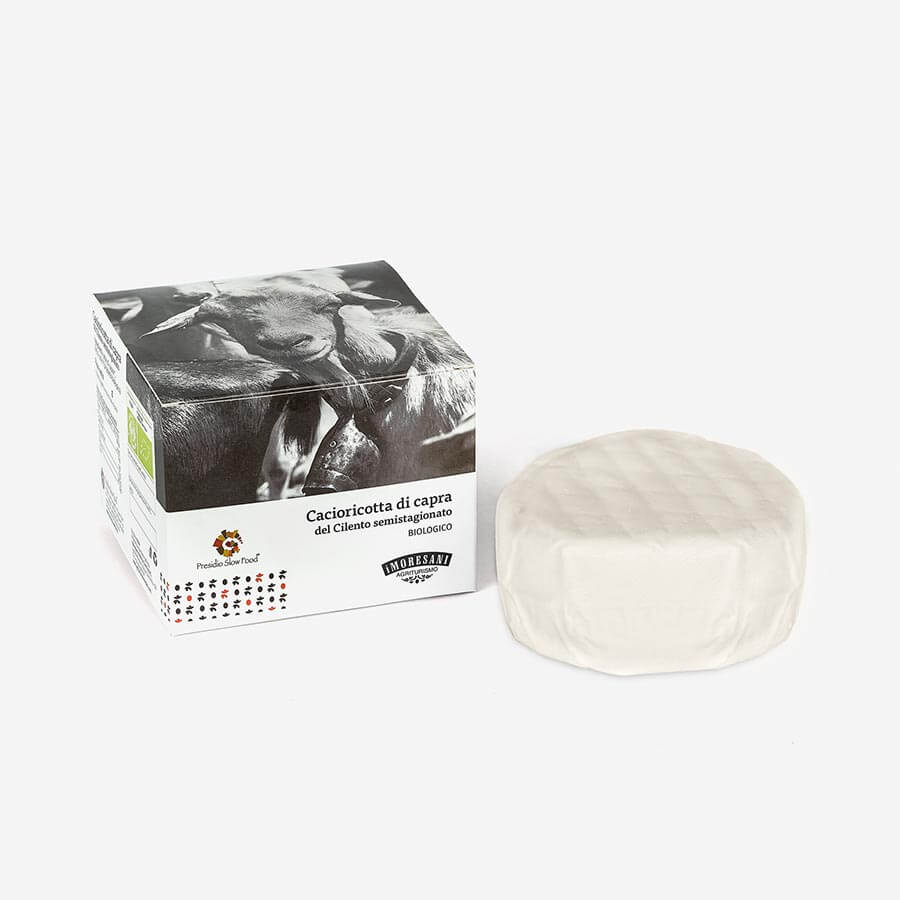
Organic mature Cacioricotta di capra del Cilento Cacioricotta del Cilento is produced with whole, thermised goat's milk. It has a cylindrical shape, no rind and a soft white paste that, as it matures, acquires a chalky texture, yellowish hues and a slightly piquant flavour.
Net weight: 280 g
Description
The name derives from the milk coagulation technique: partly rennet-based (typical of cacio) and partly thermal (typical of ricotta).
The farm owns about 100 Saanen goats. Depending on the season, the animals are raised at pasture on approximately 100 hectares of farmland, where they feed on wild plants, or housed indoors, where they are fed with fodder and cereals produced on the farm using organic methods.
CACIORICOTTA DEL CILENTO
One of the symbols of southern Italian cheesemaking tradition. Animal welfare: reproduction is natural and takes place on the farm. The animals do not undergo any mutilation and the kids are fed their mothers' milk. At night and during periods of indoor housing, the goats are kept in shared pens with straw bedding.
Animals at the end of their productive life and kids destined for slaughter are transferred to a slaughterhouse located about 30 kilometres from the farm.
Processing: Kid rennet is added to the milk, which comes from 2 milkings. The curd forms and is broken into granules, heated, placed in cylindrical moulds and pressed by hand. The cheese is dry-salted and no starter cultures of any kind are used in its production. Production period and maturation: Cacioricotta del Cilento is produced almost all year round and matures in climate-controlled rooms for up to 60 days. Its shelf life can be extended if the cheese is stored in glass jars or terracotta crocks filled with extra virgin olive oil.
The cheese: Cacioricotta del Cilento is produced with whole, thermised goat's milk. It has a cylindrical shape, no rind and a soft white paste that, as it matures, acquires a chalky texture, yellowish hues and a slightly piquant flavour. The name derives from the milk coagulation technique: partly rennet-based (typical of cacio) and partly thermal (typical of ricotta).
The area: Agriturismo I Moresani rears kids and produces cacioricotta in Casal Velino, in the Cilento, Vallo di Diano and Alburni National Park, at an altitude of about 170 metres.
The animals: the farm owns about 100 Saanen goats. Depending on the season, the animals are raised at pasture on approximately 100 hectares of farmland, where they feed on wild plants, or housed indoors, where they are fed with cheeses and cereals (maize, field beans, peas, barley) produced on the farm.
Product information
Origin: Italy
Ingredients
Ingredients:
Goat's milk*, rennet, salt.
(*organic product)
Nutritional values
Average nutritional values per 100g of product
| Energy | 1819 KJ - 438 Kcal |
| Fat of which saturates | 34 g 24 g |
| Carbohydrates of which sugars | 0 g 0 g |
| Fibre | 0 g |
| Protein | 33 g |
| Salt | 2 g |